Showing posts with label animals. Show all posts

28 Dec 2015

Could you slit an animal's throat?


It's a harsh question. A horrible question. And while I apologise to anybody who is upset by this question, it needs to be asked.

To get meat, we must kill. It's a concept most people understand - but unfortunately, it's a concept very few people will acknowledge. For many people, it is easier to ignore the truth about meat than to make an effort to change. Many people will eat meat, several times a day, without a second thought. But what if they had to slaughter the animal? What if they had to choose their victim? Would that make any difference at all?

I know, personally, that I could never intentionally slaughter or harm another living creature. And, to be consistent in my morals, I choose not to pay for other people to kill animals for me. That, plain and simply, is why I'm vegan.

"I know there are many people out there who aren't vegan, and yet they too would never harm an animal. Most people have kind, compassionate hearts. Most people don't want to hurt anyone."

But I know there are many people out there who aren't vegan, and yet they too would never harm an animal. Most people have kind, compassionate hearts. Most people don't want to hurt anyone. Morals and ethics are deeply ingrained in our culture, and one of our strongest morals is the idea that killing is wrong. So for many people, given the task of slitting a living animal's throat, they would turn away in horror and disgust. They couldn't go through with it. Many people refuse to even watch videos of this kind of behaviour.

So that's why I ask this question.

Could you take a knife, slice an animal's neck, watch he or she bleed out and die, slice his or her body to pieces, cook these pieces and eat them?

Could you?

Just reading these words sickens me. And I know many other people would feel the same. These words are uncomfortable and unsettling.

So why do we allow it to happen, on a huge scale - a scale of billions, every single day? Why do we pay money to keep this horrific industry afloat?

I believe that moral consistency is very important. I believe that if we think killing is wrong, we should not pay for it to happen.

I believe that moral consistency is very important. I believe that if we think killing is wrong, we should not pay for it to happen. It is a very simple concept, and it is why I have never wanted to eat meat.

Of course, I should address one thing. There are people out there who would happily slit an animal's throat and eat its body. Those people are not the target of this article. I am not going to waste time with somebody who simply doesn't care. But many people are kind and compassionate towards animals. Many people care a lot. All they need is a guiding hand. That's what I am offering with this article.

The reality of slaughterhouses 

If you're doubting whether or not these animals are killed by such gruesome means, I invite you to read this page. It contains accounts of actual slaughterhouse activities written by actual slaughterhouse workers.

Bill Haw, CEO of Kansas City's National Farms writes this:
Well, the slaughterhouse is not a pretty thing. I mean, it's a necessary process. It's a highly efficient process. But it's not now, nor never will be, a very pretty thing. Animals come there to die, to be eviscerated, to be decapitated, to be de-hided -- and all of those are violent, bloody and difficult things to watch. So your first and foremost impression of at least the initial stages of the packing house are a very violent, very dehumanizing sort of thing.
But the fact is, we are meat eaters, most of us. And it's a highly efficient way and a reasonably humane way. The animals are rendered unconscious before any of this happens. I think there's a concern for humane treatment of the animals. But the process itself is a violent and unpleasant sort of thing. ...

What he says is both true and false. The violence he describes, however shocking, is accurate. In saying this, he also justifies his actions through claiming that slaughtering animals is necessary and humane. The first is a matter of fact, and the second of opinion. It is a fact that humans do not need to eat animals to thrive and survive. There are millions of healthy vegans and vegetarians proving that every day. Secondly, if we describe humane as "having or showing compassion or benevolence", then Bill Haw must be wrong, because there is nothing compassionate or benevolent about killing without good reason.
And what's more, Bill Haw describes the dehumanisation of slaughterhouse workers. This is a horrible thing to subject a person to - the loss of their sense of self, of humanity. Slaughterhouses are bad not only for the animals, but for all involved in the horrible process, humans included.

Moral consistency is important

Is it natural for humans to eat meat? Some say yes, some say no. It's arguable. Some say we should make logical rather than emotional decisions, but our entire human lives are based around emotion. What's not arguable is that human society is a society based on morals. Nearly every day, we make decisions based on their ethicality. We live by a system of what's right and wrong, and if we choose to disobey this system, we end up in jail, or are shunned by our fellow humans.

There are two major issues to which humans are strongly opposed: killing and abuse. Needless killing and abuse both go against society's morals - so much so that committing these acts could land you on death row (another issue that is subject to moral debate). We are intelligent creatures able to understand when killing is okay and when it's not. In self-defence, killing is usually justified. If a bear is attempting to rip you limb-from-limb, it's okay to fight back. If a human is trying to kidnap you, it's okay to fight back. But if a human is casually walking by, minding their own business, not harming anybody, it's not okay to kill them. And if a bear is prowling through the forest, seeking shelter or food, it's not okay to kill it. And it's not okay to harm or abuse the beast. What are you doing in the bear's territory, anyway?

"I am morally opposed to necessary killing, and so I will not pay for necessary killing to happen. I will not give my money to an industry that needlessly kills, regardless of how "humanely" the killing is done."

These are the morals we live by. So why should things change when cows, pigs, sheep, and other commodified animals enter the picture? To reiterate what I said earlier: I am morally opposed to necessary killing, and so I will not pay for necessary killing to happen. I will not give my money to an industry that needlessly kills, regardless of how "humanely" the killing is done.

Death is death, life is life, and morals are morals. I shouldn't ignore my morals and push them to the back of my mind, out of sight and out of thought, to justify doing something that's convenient or traditional. I hope you, or whoever you share this article with, take this idea into consideration the next time you or they give money to a slaughterhouse.

If you are interested in veganism, I have many useful resources on my blog: here, here, here and here. You could also check out Veganuary, a project encouraging people to try veganism in the new year. Thanks for reading.

26 Jun 2015

From Animal-Loving Child to Meat-Loving Adult - Why Do We Lose Our Compassion?


I've always been an animal-lover. I was very young when I decided to become vegetarian, and loved to draw pictures of animals. I made anti-animal cruelty posters and stickers spouting slogans such as "Animals aren't hurting you, so why do you hurt them?"

I was aware of the mistreatment of animals from a young age. This was both good and bad for me. On one hand, I was able to recognise why it was bad to eat meat, but on the other hand, I was very confused about why most people ate it anyway. Many of my friends and their parents seemed to be animal lovers too. They all had dogs and cats and fish and birds, and they loved them, cuddled them, and treated them like family. They thought lambs and piglets and bunnies were adorable. So, I thought, if they loved animals so much, why did they chop their delicate bodies into little pieces, pick the pieces up with a fork and shove them into their mouths? It made no sense to me then, and still confuses me to this day.

"If we look at the children's entertainment industry, we can see just how prevalent animals are in their lives. The majority of characters in children's TV shows - especially those made for very young children (5 and under) - are anthropomorphic animals."

If we look at the children's entertainment industry, we can see just how prevalent animals are in their lives. The majority of characters in children's TV shows - especially those made for very young children (5 and under) - are anthropomorphic animals. Peppa Pig, Kipper, My Little Pony, Sesame Street, Looney Tunes, Spongebob Squarepants, Arthur and Franklin the Turtle come to mind. There are many film examples as well: The Lion King, Bambi, Chicken Run, Babe, The Aristocats, The Land Before Time, Shrek, Over the Hedge, Finding Nemo. . . the list goes on.  There are plenty of books out there too. The Berenstain Bears, Charlotte's Web and The Cat in the Hat are just three examples.

All of this just about proves it. Kids love animals! It seems, even, that they see animals as thinking, feeling creatures with unique personalities. The way they are portrayed in children's entertainment demonstrates this idea.

Most of us have fond memories of playing with our childhood pets; heading off on grand adventures, referring to them as our very best friends in the whole world. Many of us would have screamed, kicked and cried at the thought of our animal friends being harmed in any way.

When did she change from "friend" to "food"?

So where did it all go wrong? When did we decide that animals were objects for human use and consumption? When did we stop calling them our best friends?

"When did we decide that animals were objects for human use and consumption? When did we stop calling them our best friends?"

Most people, it seems, were influenced by the culture they grew up in. Their parents ate meat, their grandparents ate meat, their friends and extended family ate meat - so, they thought, it must be normal. To them, animal death may be sad, but it's just the way things are and, in their eyes, there's nothing they can do about it. Perhaps they see it as a "necessary evil." Meat-eating is such an enormous part of our culture - entire holidays seem to revolve around it (i.e. the traditional Thanksgiving turkey and Christmas ham).

And then there's the advertising. In my own country, where (to some) meat-eating is considered an imperative part of Australian culture, there are some very in-your-face advertisements encouraging the Australian population to eat more meat. If you don't eat it, they say, you're un-Australian. You're strange, unusual, not normal. Here's a particularly ridiculous example of one such advertisement:


For many people, it's difficult to stray from "traditional" family dinners of meat-and-three-veg. It's hard to stray from the strongly-ingrained ideas that meat, dairy and eggs are necessary parts of a healthy, balanced diet. Fortunately, however, it's not impossible. We just need to give these people a little bit of "veg-spiration"!

"For many people, it's difficult to stray from 'traditional' family dinners of meat-and-three-veg. It's difficult to stray from the strongly-ingrained ideas that meat, dairy and eggs are necessary parts of a healthy, balanced diet."

Some people, unfortunately, just don't care about animals at all. Eating meat is much more important to them than the lives of animals, and there's not much we can do about that. The majority of people, however, do care about animal suffering. They haven't necessarily lost their childhood compassion - they just haven't yet tried to break free of the idea that meat-eating is necessary for our survival. All these people need is a push or two in the right direction. Education is the best way to go about this - show people recipes, cook for them, help them learn just how healthy and fulfilling a vegan lifestyle can be. Make sure they're aware of the suffering animal products cause - help them remember how they felt about animals before they were lead to believe that meat is a necessity.

People are drawn to animals from an early age. For the most part, we love them, and they love us. Most people could never lay a violent hand on an animal. Most people could never slit a cow's throat or violently castrate a piglet, but this is exactly what many helpless animals must go through to end up on our dinner-plates. If we work together to act compassionately and free these innocent animals from their violent fates, the world will be a much better place for all of us. I guarantee it.

22 Feb 2015

Opinion: Should Vegans Feed Their Cats Meat?


One of the largest ongoing debates within the vegan community regards the question of whether or not vegans should feed meat to their feline companions. There are a plethora of arguments originating from both sides of the field, so it can be extremely difficult to know what (or who) to believe. Opponents of a plant-based diet for cats argue that cats are obligate carnivores, meaning meat consumption is essential for their health. Proponents of the idea argue that cats can live healthily on a plant-based diet, and that synthetic taurine (an essential dietary requirement for cat health - found naturally in animal products) can be used in place of standard taurine.

I am by no means an expert in the field of feline health, nor have I conducted any extensive research on the subject. Several followers of my blog, however, have suggested that I tackle the issue of vegan cats; so I will do my best to provide an informed opinion.

It's a matter of necessity

To determine whether or not it's morally acceptable for vegans to feed meat to cats, we must take the matter of necessity into account. At the very least, we can be one-hundred percent certain that meat consumption is not necessary for human health. Necessity forms the very basis of veganism - that is, unnecessary killing goes against our moral code. If, however, it is necessary for cats to eat meat, this wouldn't break the vegan moral code, as necessary killing (such as when lions hunt their prey) is acceptable.

Of course, whether or not it's necessary for cats to eat meat is a much debated topic. Since I'm not formally educated on the subject, I choose to sit on the fence - although I tend to lean towards the belief that meat is essential for cat health, as all other members of the feline family (tigers, lions, leopards) are famously carnivorous.

To sum up:
  • If meat-eating is essential for feline health, it does not break vegan code
  • The general consensus seems to be that cats are obligate carnivores, therefore they must eat meat
Cats are typically seen as carnivorous animals
Cat food comes from factory farms

This is an understandable concern to have. The majority of store-bought cat food is produced through incredibly inhumane, unethical and horrific practices. As vegans, we are overwhelmingly opposed to this kind of behaviour, which is a significant part of the reason why we don't purchase meat, dairy or eggs. However, can we except ourselves from this rule if we are buying meat for a cat rather than for ourselves?

At least to some degree, I don't think so. If we choose to feed animal products to our cats, we should try our very best to source the animal products from more "reputable" businesses. It can be difficult to think of any meat-producing business as reputable or ethical, but it's at least true that some are much better than others. I think the best choice is to source cat food from local fisherman rather than from large-scale factory farms or corporations.

To sum up:
  • Mainstream, store-bought cat food is sourced from inhumane and unethical factory farms
  • Cat food should be sourced from more reputable businesses if possible
  • Try buying from local fisherman or butchers
Should we only adopt herbivorous animals?

In order to avoid this problem all together, vegans could simply choose not to adopt cats, and to only adopt herbivorous or omnivorous animals that can healthily subsist on a plant-based diet. Unfortunately, this option has its downfalls. Thousands of cats are dropped in shelters each and every day; and many of which will be immediately killed. Through adopting these helpless animals, we save lives. In order to save the lives of these animals, however, we (if cats need meat to survive) must support the killing of other animals (mainly fish, to feed the cats). It's a difficult and confusing choice to make.

If we adopt cats and feed them meat, animals will die. If we don't adopt cats at all, animals will die. If we adopt cats and feed them plant-based food fortified with taurine, are we really doing what's best for them? Or will it harm - and eventually kill - them in the long run?

To sum up:
  • Vegans could choose to only adopt herbivorous animals
  • If we choose not to adopt cats at all, thousands will die in shelters
  • If we feed cats plant-based diets, their health may suffer
  • It's difficult and confusing to know the right thing to do
In conclusion...

Since there are so many conflicting opinions and arguments regarding the issue of cats eating meat, it can be extremely difficult to figure out what's right. In this case, I think it all comes down to a matter of personal choice. Do what feels right to you. If you have cats and believe meat is necessary for their health, that's fine - it doesn't make you any less vegan. Just try your best to avoid purchasing cat food sourced from factory farms. If you have cats and choose not to feed them meat - that's your choice as well, and it doesn't make you any less vegan - but please make sure your decision is based on a lot of research, and that you're certain you're doing what's right for your feline friend. If you choose only to adopt herbivorous animals - such as rabbits, mice and rats - that's fine too.

14 Feb 2015

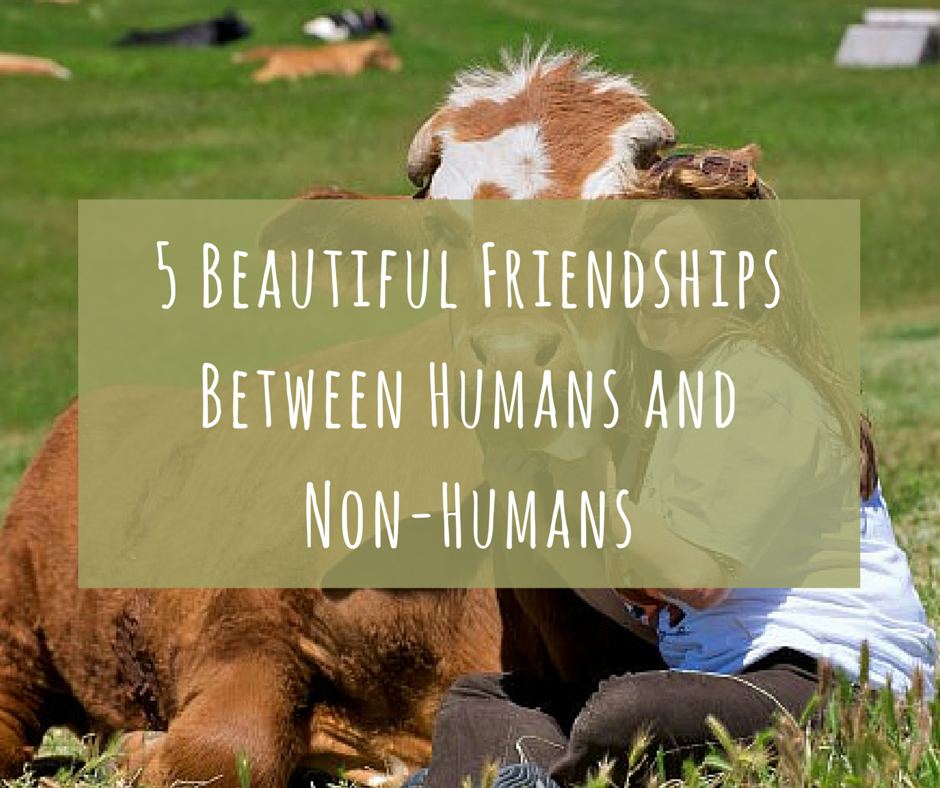
5 Beautiful Friendships Between Humans and Non-Humans


Sometimes, the bond between humans and animals goes far beyond the conventional relationship of a man and his dog. Although kittens, puppies, bunnies and birds make excellent companions, the list doesn't stop there. For some, the comfort of a loving friendship with a pig, a cow or a chicken is just as wonderful, unforgettable and unbreakable. Farm animals are highly intelligent, loyal and loving - just as much as the dogs and cats we know so well.

Here are some examples of beautiful friendships between humans and non-humans. These animals exist as unmistakable proof that all life deserves love.


Esther the Wonder Pig and her dads

Esther is one inspirational pig. Alone, she helped her human companions not only to discover veganism, but also to open up their very own sanctuary for rescued farm animals. Originally thought to be a 'mini pig', Esther shocked her companions as she continued to grow to an enormous size! She has a strong social media presence and, with her beautiful smile and loving disposition, Esther the Wonder Pig has influenced people around the world to become vegan.

The unbreakable bond between Esther and her dads is often expressed through warm cuddles and heartwarming smiles, as demonstrated in the photo below. Esther also has an amiable relationship with her feline and canine companions - they're all just as enthusiastic about cuddles as her human friends!

Esther with her loving family

"The unbreakable bond between Esther and her dads is often expressed through warm cuddles and heartwarming smiles."

Gevan and Sharon

Gevan is a beautiful highland heifer with fur of ginger and spun gold. Her companion, Sharon, is the highly dedicated and loving owner-operator of C-A-L-F Sanctuary. Gevan is one of many beloved rescues. Together, the two make an inseparable pair. Gevan's name, an anagram of vegan, is fitting - she's a compassionate and loving girl who adores the company of her human and non-human companions.

Sharon first discovered Gevan alone in a field and was heart-wrenched with sadness and despair. She promised she'd do whatever she could to help the poor girl - and that she did. Sharon saved Gevan from a life of loneliness and suffering, and the adorable, fluffy cow is clearly grateful. Every time Sharon visits Gevan in her field, she raises her head in anticipation, and she gazes longingly after her friend every time she leaves.

Sharon and Gevan

Milkshake and Beth

Milkshake, a 544kg cow, spent almost the entirety of her life cruelly confined within a pen no wider than three metres long and three metres wide from only two weeks of age. Unlike the majority of these wonderful animals, Milkshake was lucky - she was rescued by the Grace Foundation, an organisation dedicated to saving the lives of abused and neglected farm animals.

Beth DiCaprio and Milkshake have an enviable friendship built on a strong foundation of love, trust and gratitude. Milkshake is eternally grateful for Beth's gentle care - she is known for following her all around the ranch! In a YouTube video by the Grace Foundation, Milkshake can be seen jovially skipping along, never straying far from her beloved caretaker and friend.

"Beth DiCaprio and Milkshake have an enviable friendship built on a strong foundation of love, trust and gratitude."

Beth and Milkshake

Opie and Gene

Opie was a treasured member of the Farm Sanctuary family for 18 years. Over twenty years ago, in 1990, Opie was saved from a short lifetime of commodification and suffering. When Gene Baur found Opie left for dead, shivering in the wintry breeze, he chose to save the innocent baby's life. Opie was treated by a veterinarian and went on to make a full recovery. Opie's peaceful spirit radiated around the sanctuary, bringing joy to all - especially Gene.

The time of Opie's passing was difficult for Gene, but his lasting impact and memories he left behind will live on forever. Their friendship remains strong despite Opie's absence in the living world. The love shared between these two kindred spirits is demonstrated perfectly in the image below.

Gene and Opie share a memorable moment
Hank and Jenn

Hank, a 15-pound broiler rooster, was loved by all at Catskill Farm Sanctuary. His calming demeanor and loving attitude was infectious, and all who met him fell in love. Hank's love, however, was directed primarily towards one woman - Jenn Mackey, Catskill's Animal Care Coordinator.

Although Hank is no longer with us, his relationship with Jenn Mackey lives on through memories, photos and beautiful words. Every morning, Jenn would warmly greet the majestic bird, and he would call back every time without fail. Hank would softly bury his head in Jenn's arms, or rest his head on her chest and wrap his feathery wings protectively around her.

Here's a wonderful quote from Jenn:
"Hank has taught me so much more than any book or study ever could about the emotional capacity of chickens. I can't really find the words to express how much I love him."

Despite common belief, farm animals are just as capable of love and complex emotion as any other animal on Earth - including humans. As demonstrated in the above photographs, the friendships formed between humans and farm animals can be just as strong as the relationship you may have with your feline or canine companion. Cats, dogs, chickens, cows, humans, sheep, pigs and all the rest are all deserving of respect, freedom and love. 

And how can we give these innocent, benevolent beings the happiness they deserve?

The answer's simple - by going vegan.

s

31 Dec 2014

Is It Vegan to Kill Insects?


If you're vegan or vegetarian, chances are you've been deemed 'hypocritical' at some point in your life. It's usually non-vegans who are the hypocritical ones - so why would we ever be labelled as such? Well, perhaps we've swatted a blood-sucking mosquito. Perhaps we've bug-sprayed a large spider infestation (yeah, they're technically not insects, but we'll consider them for argument's sake). Perhaps we've stepped on an ant while trotting down the side-walk.

All of these scenarios are probable. It's likely they've happened to you. I know for sure that I've dealt with all of these scenarios, and I've been vegan all the while. Some non-vegans (some vegans as well, probably) may look upon these acts as cruel and therefore not vegan. I, however, disagree.

"As vegans, perhaps we've swatted a blood-sucking mosquito. Perhaps we've bug-sprayed a large spider infestation. Perhaps we've stepped on an ant while trotting down the side-walk."

Let's start with the blood-sucking mosquito scenario. In most cases, I would consider the murder of any sentient being completely unacceptable, but there are some exceptions to this rule. Baseless, senseless and unnecessary killing, in my opinion, is always wrong. Occasionally, however, you must kill for self-defence. You may feel remorseful for doing so, but sometimes, it's your only option.

In most cases, it's best to shoo the bothersome insect away before resorting to killing it. That's usually my choice of action. If you live in an area where mosquitoes are renowned for carrying infectious diseases, however, it's better to rid of them as swiftly as possible. To reiterate - this is an act of self-defence rather than callous greed, so it is not cruel. It is not anti-vegan.

Taking care of a spider infestation is a similar act of self-defence. If these potentially venomous creatures have invaded your home, ridding of the danger as soon as possible is the safest option. In the case of a very large infestation, poison is the simplest, safest and quickest way to remove the danger. Protecting yourself and your family is, again, not anti-vegan.

"Always and only choose the 'kill-method' as a last resort. If any other viable option exists, choose it."

Always and only choose the 'kill-method' as a last resort. If any other viable option exists, choose it. Unfortunately, we don't always have this luxury, so we must choose another course of action. If there are a manageable amount of spiders in your home, and you're certain they pose no threat to your health, safely and carefully move them outside. Use humane spider traps, catchers and repellents if possible. You can purchase an innovative 'no-kill' spider catcher here.

If any larger animal posed an immediate threat to us, our homes, or our families, we would take care of the imminent danger as soon as possible through any means necessary. I believe we should use the same approach when dealing with the smallest of critters. After all, we can make a much larger impact on the world while we're alive than while we're ill or deceased!

Regarding stepping on ants: this is something I'd call an accident. An often regrettable and dispiriting accident, but an accident nonetheless. I would never, ever go out of my way to kill an ant. I'm saddened when I watch people purposely step on them, especially children. I see it as a sign of a complete lack of respect for life.

Compassionate people go out of their way to avoid injuring all creatures, ants included. Sometimes, however, we make mistakes. Sometimes we don't see the tiny critters. Sometimes we misstep. Completely unintentional harm is not comparable to the intentional harm of paying for animals to be killed and eating their dead bodies - as such, it is not 'unvegan'. 

What about termites? Again, this is a case of home-invasion. If a rogue creature has entered your habitat with the intent of destroying it, you must do whatever's plausible to rid of the problem - as any animal would do. Sometimes, sadly, the only plausible option is to kill.

"Completely unintentional harm is not comparable to the intentional harm of paying for animals to be killed and eating their dead bodies - as such, it is not 'unvegan'."

All of this is only my opinion, and vegans have differing views on the matter. I don't speak for all vegans and vegetarians. Some don't agree with killing in any way, shape or form; and believe it is better to sacrifice our own lives than those of other sentient beings. I respect this opinion, but to me, it's unrealistic. No matter how heart-wrenching taking another life may be, it's unfair to beat yourself up. Our lives are important too, and - as aforementioned - we can't make a real impact while we're dead. Respect your own life and do whatever you can to preserve it, so long as you're trying your very best to avoid harming others. That's called being vegan.

18 Dec 2014

You Love Animals AND You Eat Meat? Impossible...


I've come across many strange people in my life, but few as mindbogglingly peculiar as self-proclaimed "animal lovers" who eat meat. In my experience, I've found this is a common thing. Many people claim to be animal lovers and go out of their way to promote animal rights to some degree (i.e. boycotting palm oil and adopting pets rather than shopping for them). What confuses me, however, is the fact that they partake in all of this animal activism while willingly and regularly consuming animal products. They say they love animals, and yet they eat them. As a vegan, I honestly can't get my head around the concept of claiming to love somebody, paying for them to die and then eating their corpse. To the people who do this: our definitions of love must be very different.

For the purpose of this article, I'll go with the most commonly accepted and largely universal definition of love:

love
lÊŒv/
noun

1. a strong feeling of affection.


2. a great interest and pleasure in something.

If this is the definition of love we're all comfortable with, then loving animals while eating meat simply doesn't add up. It's practically impossible. If a meat-eating "animal lover" told me they love me, I'd be seriously afraid, and with good reason. I'm not at all interested in being imprisoned and slaughtered in order to end up on the plate of somebody who "loves" me.

Most people love their parents, friends and partners - their pets, too - but would they pay for them to be slaughtered and then eat their dead bodies? Never! True animal lovers respect all animals in the same way they would a family member. They would never, ever do anything to harm them. 

""Animal lovers" who eat meat are really just some-animal-lovers. They love the "cute" animals, the "pretty" animals... the animals society deems deserving of love, i.e. dogs, cats, and bunnies."

I do understand that there are some people out there who genuinely love animals and still eat meat. These people are different in the sense that they haven't yet made the connection (between meat and animal suffering), but eventually will. After all, most vegans have eaten meat at some stage in their life. I'm one of them - I didn't make the connection between meat and animal suffering until I was six years old. As a true animal lover, I immediately cut out meat for good after my "big realisation". The amount of time it takes for somebody to break free of the meat-eating mould is often largely dependent on their upbringing. Some people have been brought up to believe that meat-eating is completely necessary for good health, so I can understand why it may take them a little longer to break free.

"To truly be an animal lover, you must acknowledge that all animals are deserving of love, respect and freedom, regardless of how cute and cuddly they are."

If, on the other hand, a person knows exactly where meat comes from and also knows that we don't need to eat it, they simply cannot call themselves an animal lover. You can't love somebody and willingly eat them too. "Animal lovers" who eat meat are really just "some-animal-lovers". They love the "cute" animals, the "pretty" animals... the animals society deems deserving of love. You're not an animal lover if you care solely about dogs, cats, and bunnies.

To truly be an animal lover, you must acknowledge that all animals are deserving of love, respect and freedom, regardless of how cute and cuddly they are. To only love animals that make you feel good (through their pure adorableness), in my opinion at least, is quite selfish. All animals - from cows to horses to goats to fish - experience love and pain just as dogs and cats do (some even more so). When compared to each other, for example, cows and dogs are not all that different - they look very similar, experience pain in the same way, and are both able to form deep emotional bonds with their human companions. Why love one and eat the other?

The same is true for many other animals we have been programmed to see as food. Pigs, chickens, goats, sheep, ducks - they are all capable of complex thought and emotion. Even more importantly, they can feel pain. They have families. They can suffer. If you truly loved animals, you would do anything you could to avoid inflicting pain upon them. You certainly wouldn't pay for them to be slaughtered and eat their remains! In fact, that's the complete opposite of what you would do.


The best way to show your love for somebody is to dedicate your heart and soul to granting them freedom and happiness. Veganism is a great way to do this - in fact, it's the best way. Through veganism, we advocate against the commodification of innocent and sentient beings, we promote equal love and respect, and most importantly - we save lives.

If you genuinely consider yourself an animal lover, go vegan. It'll be the best change you ever make.

10 Oct 2014

Five Fantastic Farm Animal Sanctuaries


Farm animal sanctuaries are literal life-savers. They have risen in prominence greatly over the last few years, which is absolutely fantastic, and I hope this positive growth continues over the years to come. Without farm animal sanctuaries, there would be no place for sick, old, discarded and unwanted farm animals to go when the farmers decide their time is up. Here, I have comprised a list of the most well-known farm animal sanctuaries in my experience. All farm animal sanctuary owners, employees and volunteers deserve great commendation for their selfless work. Here's a select list of five, in no particular order:

1. Farm Sanctuary


Farm Sanctuary, founded in 1986, was one of the first farm animal sanctuaries to rise to prominence. The organisation owns and operates three shelters across the United States, housing a total of over 1,000 rescued animals.

Farm Sanctuary's website is an excellent source of information about factory farming. If you know anyone who's looking to learn more about why it's important to be vegan, their website is a great option. There's also plenty of interesting information about the sanctuary's animal residents, with gorgeous photos to boot.


Many beautiful chickens, pigs, sheep, goats, turkeys, ducks, geese and cattle all call Farm Sanctuary their home. If you'd like to donate to help these peaceful creatures, visit this link. If you live nearby, you can also help out through volunteering.

2. Edgar's Mission


Edgar's Mission is an Australian farm animal sanctuary named after the owner's very first rescue pig, Edgar, who sadly passed away in 2010. He has since become known as "the pig who started it all". Edgar's Mission loves and cares for over 300 rescued farm animals, from chickens and ducks to goats and sheep.

The Edgar's Mission website provides heart-warming details about each and every animal resident, along with beautiful photographs. There is also a special page dedicated to former Edgar's Mission residents who have passed on.

If you are interested, here is link allowing you to donate to help the animals and dedicated workers at Edgar's Mission. You can also help the sanctuary through purchasing a few animal-themed products; including bags, posters, calendars, cards and books.

3. Freedom Hill Sanctuary


Freedom Hill Sanctuary, also located in Australia (in Adelaide, my home town!), was formed only recently in 2011, beginning with a tiny lamb named Lynn. Lynn, like Edgar, was the animal who inspired it all. Freedom Hill is now home to dozens of animals who have been saved from an otherwise terrible fate.


The Freedom Hill Sanctuary website offers photographs and detailed descriptions of each animal resident - I dare you to try not to fall in love with them all!

If you'd like to help the residents at Freedom Hill, please visit their homepage and choose a donation amount. Volunteering opportunities are also available, as well as annual organised fun events and fundraisers. 

4. Brightside Farm Sanctuary


Brightside Farm Sanctuary truly lives up to its name. Located in Tasmania, Australia, Brightside Farm Sanctuary helps to re-home over 500 abandoned and unwanted farm animals each year. Their sanctuary is currently home to over 250 animals. They also dedicate much of their time to promoting and advocating veganism and animal rights.

Like the other sanctuary's websites, Brightside Farm Sanctuary's online presence provides animal-lovers with tear-jerking tributes, detailed descriptions and picturesque photographs - check them out if you have the time. I promise you won't regret it!

The Brightside team's efforts to re-home over 300 dogs a year are commendable, as well as their dedication to their permanent animal residents. If you'd like to support Brightside Farm Sanctuary, visit this link to donate or this link to shop for gorgeous animal-themed products.


5. C-A-L-F Sanctuary 


C-A-L-F Sanctuary, located in England, is selflessly run by a very small team of animal lovers. Along with the sanctuary is an 100% vegan cafe, whose profits go towards helping the rescued animals. C-A-L-F is home to an array of beautiful creatures, especially Gevan, the gorgeous highland hiefer who acts as somewhat of a mascot for the organisation.

As a small sanctuary run by so few volunteers, C-A-L-F Sanctuary's residents need all the help they can get. To donate, please visit this link, or shop here. I'm certain they would also appreciate the helping hand of a volunteer, so if you live in the area, why not pay them a visit?

Meet them, don't eat them!
Without farm animal sanctuaries, abandoned, unwanted and mistreated farm animals would simply be put to death without a whisper of a thought. The selfless employees and volunteers of these sanctuaries pour their hearts out to these animals, offering them a second chance at life. We can help these wonderful charities through spreading awareness, donating and volunteering our time. It's the very least they deserve for their hard work and compassion.